
Newark Cylinders manufactures bespoke buffer vessels in copper and stainless steel, built to your exact system requirements. From 8 to 2,100 litres, with custom dimensions, connection configurations, and coil arrangements as standard.
Buffer vessels, also known as buffer tanks, store heated non-potable water for space heating systems, serving radiators, underfloor heating, and multi-source installations. Unlike hot water cylinders, they don’t supply domestic hot water for taps or showers; their job is to stabilise and manage heat within the heating circuit itself.
A well-specified buffer vessel will:
Short cycling prevention: Stop heat sources from turning on and off too frequently
Energy storage: Act as a battery to store excess power for later use (i.e. from solar panels which can produce power even when it isn’t immediately required)
System balancing: Prevent the supply and demand of power from becoming imbalanced if a heat source can’t keep up
Heat source integration: Allows multiple heat sources to work together to satisfy a high demand
Buffer vessels are particularly effective in systems with underfloor heating, multiple heating zones with different demands, or where integrating controlled and non-controlled heat sources, such as a wood burner alongside a conventional boiler, or solar thermal panels connected to an existing system.
For heat pump installations requiring minimum system volumes, see our Aquinox Heat Pump Buffer Vessels.


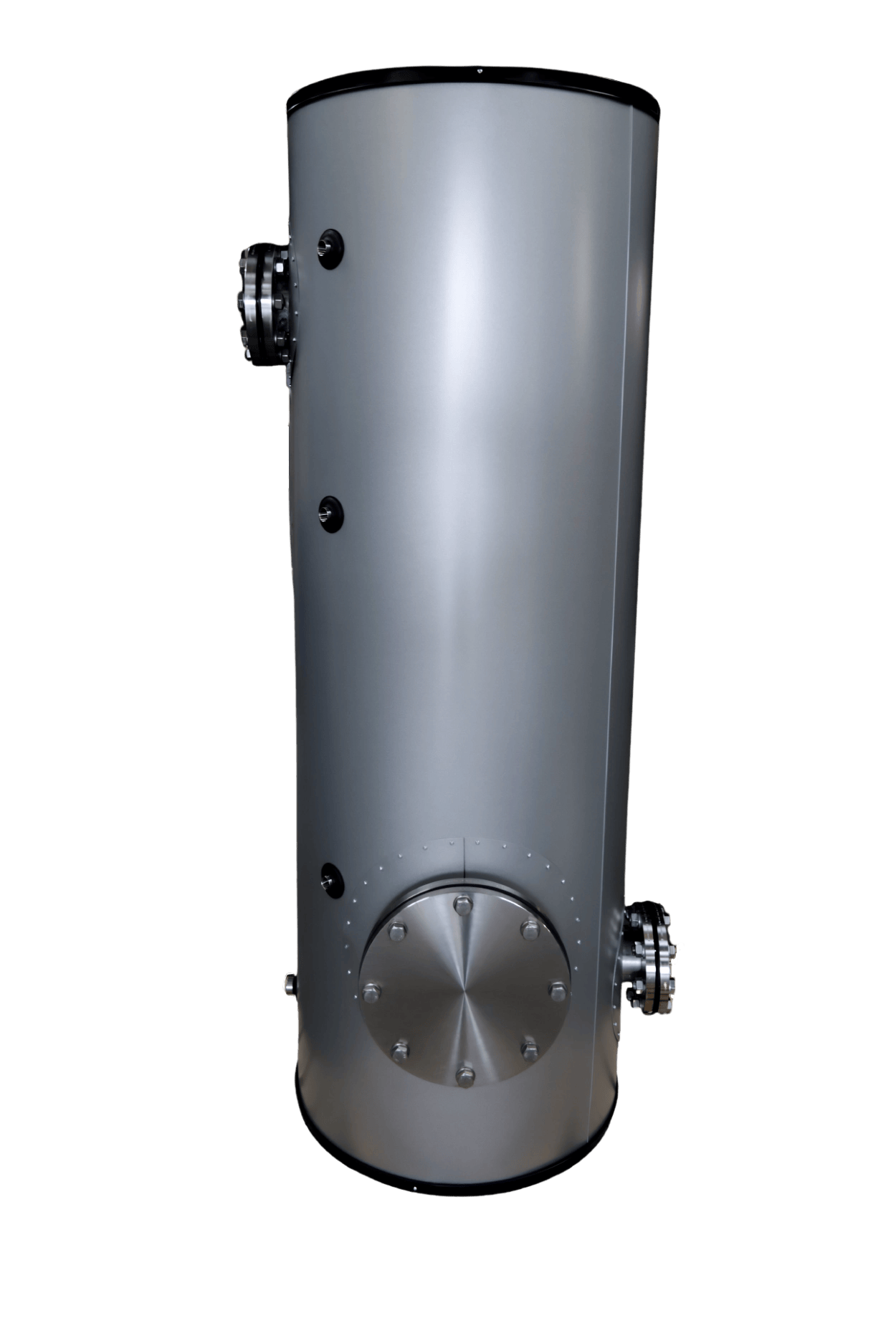

The most common purpose of a buffer is to accept the heat generated by one or more heat sources, and to store it for on-demand use in a heating system. Unlike hot water cylinders that provide domestic hot water to taps and showers, buffer vessels store heated water solely for space heating purposes.
The heat sources that buffer tanks would typically accept heated water from, include heat pumps, biomass boilers, gas or oil boilers, and solar panels. These are all considered “controllable” heat sources, as they only can be turned off with little to no overrun, ensuring the system is kept within its safe temperature and pressure limits. Basic wood-burning stoves can also be a viable heat source for buffer vessels, but due to often lacking controllability (once it’s lit, it’s impractical to put it out), they are generally only compatible with open-vented buffer vessels and heating systems which are less common.
As with all of our cylinders, we can manufacture buffer units to a wide variety of specifications, such as vented or pressurised systems, multiple heat input and output coils and materials of copper or stainless steel. We can also manufacture our buffer tanks with many different connection sizes and positions to perfectly match your system requirements.
We also manufacture a range of Aquinox Heat Pump Buffer Vessels for use in smaller domestic applications for expanding an existing system to make it suitable for a heat pump system.
The variables that we can offer within the specification of our Aquinox stainless steel buffer vessels include:
A buffer vessel stores heated water for space heating circuits only, such as radiators and underfloor heating. It does not produce domestic hot water.
If you need a vessel that also supplies hot water to your taps and showers, you’re looking for a thermal store.
Not sure which is right for your system? Get in touch, and we’ll help you work it out.
Buffer tanks can offer certain benefits in heat pump systems, although in many installations, they are not required for optimal operation. In the scenarios in which an installer deems one to be advantageous, there are many options available; however, not all buffer vessels provide an equally optimal solution
A heating engineer may recommend a buffer vessel in situations such as:
The material that buffers are manufactured from has a significant impact on how well they perform over time.
Standard mild steel buffer tanks remain a practical and cost-effective option in many heat pump installations, particularly where system layouts are simple, water quality is well controlled, and long-term adaptability is not a priority. Their widespread availability and lower upfront cost make them a sensible choice for budget-conscious or time-critical projects. They are designed to meet a basic functional requirement, but have limitations relating to system stability, heat retention, hydraulic flexibility, and adaptability.
In response to these limitations, Aquinox Stainless® steel buffer vessels offer a more robust and adaptable alternative. They represent a higher initial investment, but their value becomes more apparent in systems where system stability, low heat loss, hydraulic flexibility, and system adaptability are important considerations.
Learn about the benefits of copper and stainless steel here.
What we hear: “The SCOP figures didn’t quite match my expectations as excess heat was being lost from the buffer”
Aquinox Stainless Steel Buffer Vessels can be insulated anywhere up to an A+ rating on the ErP scale, dependent on the size of the buffer vessel.
| Buffer Vessel Size | ErP Rating |
|---|---|
| 10 – 130 Litres | A+ |
| 140 – 350 Litres | A |
| 360 – 500 Litres | B |
What we hear “I know a better layout exists, but the standard vessels just don’t allow it”
Connection sizes and positions on all Newark Cylinders products are customisable so that you can plan optimal pipe-runs in advance, add features that promote stratification (diffusers, baffles, etc), and ultimately, gain performance.
Standard buffers can’t accommodate:
What we hear: “With hindsight, I’d have added some extra connections and pockets”
With an Aquinox Buffer Vessel, you can add as many additional future-proofing features as you can realistically anticipate being beneficial.
Our range of buffer tanks comes in a comprehensive variety of sizes, manufactured in either copper or stainless steel to suit your system requirements and budget.
| Material | Sizes |
|---|---|
| Copper | 40 – 1,150 litres |
| Stainless Steel | 50 – 2,100 litres |
Select a height and diameter to calculate the approximate volume.
Standard dimensions shown. Contact us for bespoke specifications.
Filter by height and diameter to find your cylinder’s volume.
Select a height and diameter above to see the volume.
| Height (mm) | Diameter (mm) | Volume (L) |
|---|---|---|
| 900 | 375 | 92 |
| 900 | 400 | 104 |
| 900 | 450 | 129 |
| 900 | 500 | 161 |
| 900 | 600 | 220 |
| 900 | 650 | 254 |
| 900 | 750 | 308 |
| 900 | 900 | 487 |
| 900 | 1100 | 670 |
| 900 | 1200 | 700 |
| 900 | 1300 | 657 |
| 1000 | 375 | 103 |
| 1000 | 400 | 116 |
| 1000 | 450 | 145 |
| 1000 | 500 | 180 |
| 1000 | 600 | 248 |
| 1000 | 650 | 287 |
| 1000 | 750 | 352 |
| 1000 | 900 | 550 |
| 1000 | 1100 | 765 |
| 1000 | 1200 | 813 |
| 1000 | 1300 | 790 |
| 1100 | 375 | 114 |
| 1100 | 400 | 128 |
| 1100 | 450 | 161 |
| 1100 | 500 | 200 |
| 1100 | 600 | 276 |
| 1100 | 650 | 320 |
| 1100 | 750 | 396 |
| 1100 | 900 | 614 |
| 1100 | 1100 | 860 |
| 1100 | 1200 | 926 |
| 1100 | 1300 | 922 |
| 1200 | 375 | 124 |
| 1200 | 400 | 141 |
| 1200 | 450 | 176 |
| 1200 | 500 | 219 |
| 1200 | 600 | 304 |
| 1200 | 650 | 353 |
| 1200 | 750 | 440 |
| 1200 | 900 | 677 |
| 1200 | 1100 | 955 |
| 1200 | 1200 | 1039 |
| 1200 | 1300 | 1055 |
| 1300 | 375 | 135 |
| 1300 | 400 | 153 |
| 1300 | 450 | 192 |
| 1300 | 500 | 239 |
| 1300 | 600 | 332 |
| 1300 | 650 | 386 |
| 1300 | 750 | 484 |
| 1300 | 900 | 741 |
| 1300 | 1100 | 1049 |
| 1300 | 1200 | 1152 |
| 1300 | 1300 | 1187 |
| 1400 | 375 | 146 |
| 1400 | 400 | 166 |
| 1400 | 450 | 208 |
| 1400 | 500 | 258 |
| 1400 | 600 | 361 |
| 1400 | 650 | 419 |
| 1400 | 750 | 528 |
| 1400 | 900 | 804 |
| 1400 | 1100 | 1144 |
| 1400 | 1200 | 1264 |
| 1400 | 1300 | 1319 |
| 1500 | 375 | 157 |
| 1500 | 400 | 178 |
| 1500 | 450 | 224 |
| 1500 | 500 | 278 |
| 1500 | 600 | 389 |
| 1500 | 650 | 452 |
| 1500 | 750 | 572 |
| 1500 | 900 | 867 |
| 1500 | 1100 | 1239 |
| 1500 | 1200 | 1377 |
| 1500 | 1300 | 1452 |
| 1600 | 375 | 168 |
| 1600 | 400 | 191 |
| 1600 | 450 | 240 |
| 1600 | 500 | 297 |
| 1600 | 600 | 417 |
| 1600 | 650 | 485 |
| 1600 | 750 | 616 |
| 1600 | 900 | 931 |
| 1600 | 1100 | 1334 |
| 1600 | 1200 | 1490 |
| 1600 | 1300 | 1584 |
| 1700 | 375 | 179 |
| 1700 | 400 | 203 |
| 1700 | 450 | 255 |
| 1700 | 500 | 317 |
| 1700 | 600 | 445 |
| 1700 | 650 | 518 |
| 1700 | 750 | 660 |
| 1700 | 900 | 994 |
| 1700 | 1100 | 1429 |
| 1700 | 1200 | 1603 |
| 1700 | 1300 | 1717 |
| 1800 | 375 | 190 |
| 1800 | 400 | 216 |
| 1800 | 450 | 271 |
| 1800 | 500 | 336 |
| 1800 | 600 | 473 |
| 1800 | 650 | 551 |
| 1800 | 750 | 704 |
| 1800 | 900 | 1058 |
| 1800 | 1100 | 1523 |
| 1800 | 1200 | 1716 |
| 1800 | 1300 | 1849 |
| 1900 | 375 | 201 |
| 1900 | 400 | 228 |
| 1900 | 450 | 287 |
| 1900 | 500 | 356 |
| 1900 | 600 | 501 |
| 1900 | 650 | 584 |
| 1900 | 750 | 748 |
| 1900 | 900 | 1121 |
| 1900 | 1100 | 1618 |
| 1900 | 1200 | 1828 |
| 1900 | 1300 | 1982 |
| 2000 | 375 | 212 |
| 2000 | 400 | 241 |
| 2000 | 450 | 303 |
| 2000 | 500 | 375 |
| 2000 | 600 | 529 |
| 2000 | 650 | 617 |
| 2000 | 750 | 792 |
| 2000 | 900 | 1184 |
| 2000 | 1100 | 1713 |
| 2000 | 1200 | 1941 |
| 2000 | 1300 | 2114 |

This example system diagram demonstrates a large industrial application such as a farm or factory.
The buffer vessel is open-vent and is heated via the wood burner, solar panels and heat pump which can then be circulated around the radiator and underfloor heating circuit.
The unvented cylinder is pressurised, however, by using a coil, the hot water inside the buffer vessel can be used to heat the cylinder. This hot water can then be provided at high pressure to taps and showers.
A buffer vessel (also known as a buffer tank) is used to store heated water for on-demand use in a heating system. Unlike hot water cylinders that provide domestic hot water to taps and showers, buffer vessels store heated water solely for space heating purposes.
A buffer vessel acts as a thermal reservoir between a heat source and a heating system. Its primary purpose is to store heated water so the heating system can draw from it on demand, rather than relying on the heat source to fire every time there is a call for heat. This is particularly important in heat pump installations, where frequent on/off cycling (known as short cycling) can reduce efficiency and shorten the lifespan of the compressor.
By absorbing excess heat and releasing it gradually, a buffer vessel allows the heat source to run for longer, more efficient cycles while ensuring the heating system always has a ready supply of heated water to meet demand.
Buffer vessels are also used to balance systems with multiple heat sources, such as a heat pump combined with solar thermal, by accepting and storing heat from each source in a single vessel.
A buffer vessel is connected between the heat source and the heating distribution system using flow and return connections. Heated water from the heat source (such as a heat pump, boiler, or solar thermal system) flows into the vessel, where it is stored at temperature until the heating system requires it. When there is a call for heat from the building, the heating circuit draws hot water from the buffer vessel rather than directly from the heat source.
As the stored water temperature drops, the heat source is signalled to fire again and replenish the vessel. This cycle ensures a consistent supply of heated water to radiators or underfloor heating, while giving the heat source the freedom to operate at its most efficient output rather than constantly reacting to short-term fluctuations in demand. The vessel itself is typically insulated to minimise standing heat loss during storage.